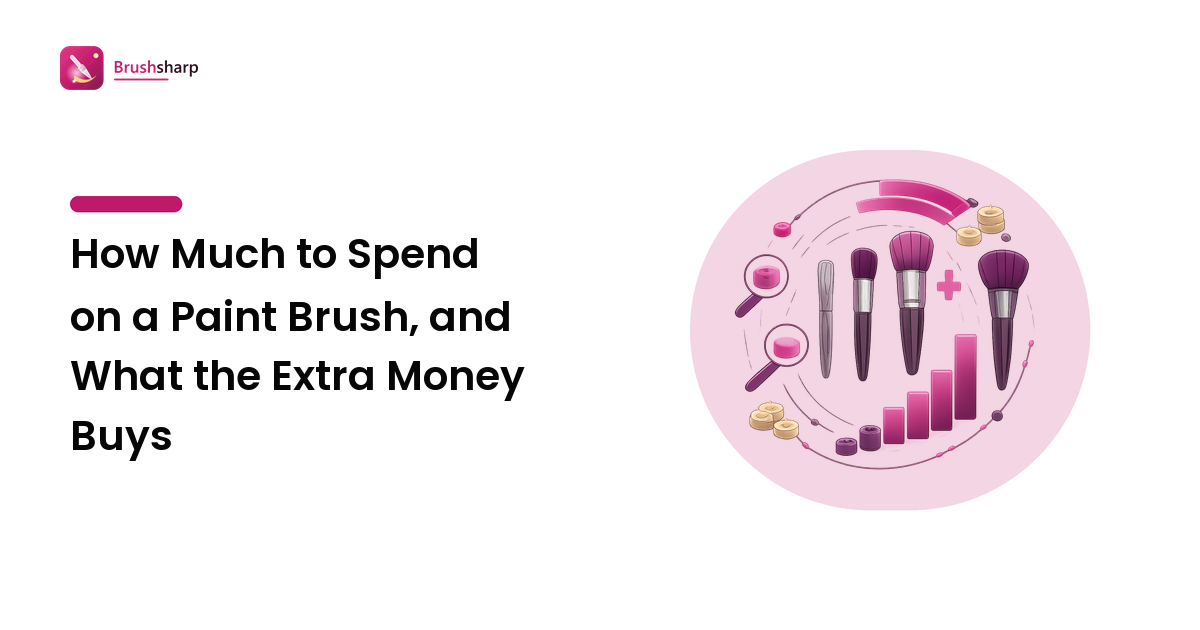
Spend enough to get three things together: flagged filament (tips split into fine strands rather than cut off blunt), a firmly crimped rust-resistant ferrule, and a hand-shaped chisel edge. That combination is where price starts buying finish quality. Below it you are buying a disposable tool that sheds and leaves marks. Above it you are mostly paying for specialization — particular paints, particular finishes — that a homeowner painting rooms rarely needs.
Which means the useful question is not "what does a good brush cost" but "what am I paying for, and does this job need it?" The construction details behind the price are visible in the shop if you know where to look, and the real cost of a brush includes what happens after you buy it.
What actually drives the price of a paint brush?
Brush prices vary enormously for reasons that are physical rather than mysterious. Each of these adds cost, and each earns it in a different way.
How the filament tips are finished. Cheap brushes are made from filament cut to length, leaving blunt ends. Better brushes have tips that are flagged (split into finer strands) or tapered so each filament is thinner at the tip than at the base. That taper is what lays paint down smoothly instead of dragging it, and it is the single biggest driver of both price and finish.
Filament blend and quality. A mix of diameters and stiffnesses lets a brush hold plenty of paint while keeping a precise edge. Blending costs more than filling a brush with one uniform filament. Natural bristle, where it is used, has its own cost structure entirely — the comparison is covered in synthetic vs. natural bristle brushes.
Density and how much is actually in there. Two brushes the same width can hold very different amounts of paint. More filament means fewer trips to the tin, and it also means more material and more work to set into the ferrule.
Hand-shaping. A chisel edge — where the head tapers to a fine line across the tip — is what cuts a straight line against a ceiling. Achieving it reliably takes shaping and trimming beyond simply gluing a bundle in place.
The ferrule. The metal band is doing structural work: holding the filament in epoxy, resisting rust, and staying tight through repeated soakings. Stainless or well-plated ferrules with a proper crimp cost more than thin plated steel that swells, loosens, and starts shedding hairs.
Handle and balance. Not vanity. A handle shaped for the grip you use, on a brush that balances near your fingers, is what stops your hand aching after an hour of cutting in — and a tired hand is what puts a wobble in the line.
Brand and retail margin. Some of the price is manufacturing labor and quality control, and some is neither — which is exactly why the in-hand checks further down matter more than the label.
What does spending more actually get you at the wall?
Five things, all of which you can see:
- Fewer brush marks. Finer, tapered tips release paint more evenly, so the surface levels out instead of holding ridges. If ridges are your current problem, the causes are broken down in why your brush leaves streaks.
- Fewer reloads. A denser head carries more paint per dip, so you cover more before going back to the tin — noticeable across a whole room.
- A cleaner cut-in line. A true chisel edge lets you paint to an edge without tape. This is where most people first notice the difference.
- No shedding. Loose hairs in wet paint have to be picked out and the patch reworked. A well-set ferrule mostly ends that.
- It comes back into shape. A good brush washed and dried properly returns to its original edge. A cheap one splays permanently after a couple of jobs, which is what makes it expensive per use.
Where does spending more stop paying off?
Diminishing returns arrive earlier than the display wall suggests.
- Specialist brushes for general work. Brushes built for particular finishes or particular paints solve problems most decorating jobs do not have.
- Very large premium brushes for wall areas. Large flat surfaces are usually rolled or sprayed. A wide brush that rarely gets used is money resting in a drawer.
- Sets. A boxed set is priced on the count, and typically contains two sizes you use constantly and several you never touch. Buying singles costs more per brush and less overall.
- A great brush with untrained technique. Overloading, pushing rather than laying off, and painting over half-dry edges show through any brush.
- Abrasive or solvent-heavy work. More on that below — genuinely a job for the cheap one.
How many brushes do you actually need?
For most home decorating, a small set covers nearly everything, and buying it well costs less than replacing a drawer of bad ones.
- A small angled sash brush. The workhorse: cutting in edges, corners, and around frames. Buy your best-quality brush here, because the chisel edge is doing the visible work.
- A medium flat or angled brush. Doors, trim, skirting, furniture. Worth good quality, since brush marks show most on woodwork.
- A cheap brush kept deliberately cheap. For adhesives, wood preservative, rough masonry, fence stain, and anything you would rather not put your good brush through.
Buying a fourth or fifth adds convenience rather than capability. Two good brushes and one sacrificial one will out-perform an eight-piece bargain set on any job in a house.
What does a brush cost after you buy it?
The purchase price is only the visible part, and the rest is where cheap brushes quietly get expensive.
Cleaning materials. Water-based paints need only warm water and a little soap. Oil-based and varnish work needs the solvent the paint's own label specifies, which is a recurring cost and the main reason to keep a dedicated cheap brush for those jobs. Work in good ventilation, keep solvents away from heat and flames, let solvent-soaked rags dry flat outdoors before disposal rather than balling them up, and take used solvent to a proper disposal point instead of the drain.
Your time. A brush cleaned within minutes of finishing takes a few minutes. One left overnight takes far longer or does not recover at all — see how to clean paint brushes for the routine, and note that the cheapest way to make an expensive brush good value is to clean it promptly.
Replacement cadence. This is the number that actually matters, and it is driven by care rather than by price: how quickly you wash it, whether it ever stood on its tips in a jar, whether it dried fully before storage, and how rough the surfaces were. A modest brush that is cleaned properly outlasts a premium one that is not.
Wasted paint and rework. A shedding brush costs you picked-out hairs and touch-ups. A brush that leaves ridges costs an extra coat. Neither shows up on the receipt.
Is a cheap brush ever the right choice?
Often, and choosing one deliberately is a sign you know what you are doing. Reach for the cheap brush when:
- The medium is destructive: adhesives, strong solvents, wood preservative, some primers.
- The surface is abrasive: bare masonry, rough render, weathered fence boards.
- The job is small and the cleanup is disproportionate — a single touch-up in a paint you will not use again.
- Someone is helping who will not clean up afterward.
- You are working somewhere awkward and the brush may not come back.
The mistake is not owning cheap brushes. It is owning only cheap brushes and cutting in a straight line with one.
How to tell in the shop whether a brush is worth its price
These take under a minute and tell you more than the packaging.
- Look at the tips against the light. Fine, feathered, slightly uneven ends mean flagged or tapered filament. A blunt, evenly cut edge means the cheap process, whatever the price.
- Tug a few filaments gently. Anything that comes away in your fingers will come away in your paint.
- Splay the head against your palm and release it. It should spring back to a clean edge, not stay fanned.
- Feel for the chisel. Run a thumb across the tip: the head should taper to a thin edge rather than ending square.
- Check the crimp. The ferrule should be tightly closed with no gaps, and the head should feel solidly set, not loose in the metal.
- Weigh it in your hand. It should feel balanced near the ferrule, and the handle should suit the grip you actually paint with.
If a brush passes all six, it is worth what it is asking. If a premium-priced brush fails two of them, you are paying for the label.
FAQ
Do expensive brushes make a difference with cheap paint?
Less than you would hope. Paint quality largely governs coverage and how well the surface levels; the brush governs marks, edges, and control. A very good brush cannot make a thin paint cover, but it will still cut a cleaner line.
Are natural-bristle brushes worth the extra?
Only for the paints they suit. Natural bristle behaves differently with water-based products than with oil-based ones, so the choice is about the material you are applying rather than about quality — the trade-offs are set out in the synthetic versus natural comparison.
How long should a good paint brush last?
There is no honest number, because the deciding factors are how soon it is washed, whether it dried in shape, and what surfaces it met. Cleaned promptly and stored flat or hanging, a well-made brush stays serviceable for many jobs; left to harden once, it may not survive the week.
Is a brush set better value than buying singles?
Usually not. Sets are built around a count, so you pay for sizes you will rarely lift. Two brushes chosen for the jobs you actually do will serve you better than eight chosen by a packaging designer.
Can one bad job ruin an expensive brush?
Yes — leaving it loaded until the paint dries, standing it on its tips in a jar, or using it on rough masonry can permanently deform the head. This is exactly why the sacrificial brush exists.
Price in a paint brush is not arbitrary: it tracks flagged filament, blend, density, hand-shaping, and a ferrule that stays tight. Spend where those show up — the brush that cuts your lines — keep a cheap one for the punishing jobs, and remember that prompt cleaning changes the cost-per-job more than the price on the handle ever will. For more on choosing and looking after brushes of every kind, visit Brush Sharp.