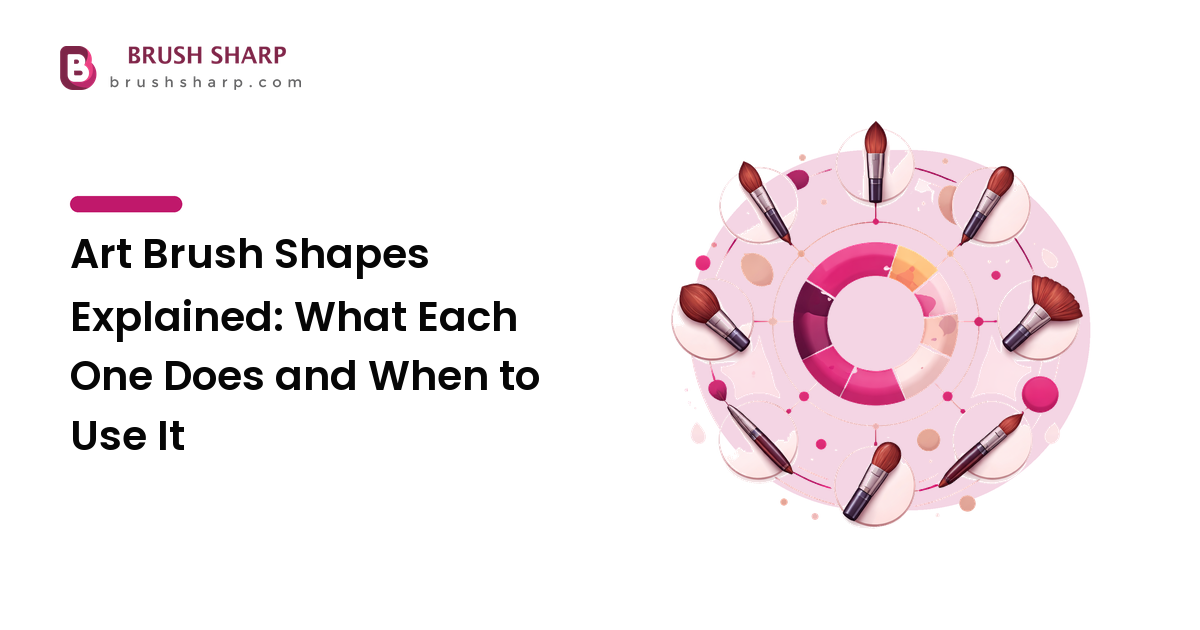
The same tube of paint and the same steady hand can leave a hair-thin line, a crisp edge, or a soft cloud — and the difference is the shape of the brush. Of all the choices an artist makes, brush shape is the most under-rated: painters will agonize over paint brands and forget that the silhouette of the tip is what actually lands on the surface.
Here is the takeaway up front: the outline of a loaded brush tip is the outline of the stroke it makes. Rounds draw lines and hold points; flats and brights cut edges and lay blocks; filberts do soft-edged everything; and a short list of specialty shapes exist to make one specific mark well. Learn what a handful of shapes do, buy those, and you can paint almost anything.
How brush shape decides the mark
Every brush does two jobs at once, and its shape balances them. The belly — the fatter part of the bristle bundle above the tip — is a reservoir that holds paint. The tip or edge is the business end that presses paint onto the surface. Shape decides how much each end dominates: a big round has a generous belly and a fine point, so it carries a lot of paint and can still draw a line; a bright has almost no belly, so it holds little but gives you precise control.
Bristle length matters just as much as the outline. Long bristles hold more paint, spring back energetically, and move loosely — great for expressive strokes, harder to control. Short bristles hold less, stay stiff, and go exactly where you push them, which is why detail and heavy-paint brushes tend to be short. So read a brush as shape plus length: the same square "flat" outline behaves very differently long (a flat) versus short (a bright).
Round brushes — the do-everything shape
If you own one art brush, make it a round. The ferrule is round and the bristles taper to a point, and that is what makes it so versatile: paint with just the tip for fine lines, lettering, and detail, then press down onto the belly for a stroke as wide as the brush is round. Large rounds hold enough liquid to lay a small wash; small rounds pick out eyelashes and highlights.
The round is the watercolor workhorse — a single well-made round can carry most of a painting, from broad first washes down to the final details, because it both holds water and keeps a point. That last part is the catch: a round is only as good as its point. A splayed or hooked tip turns your precision brush into a blunt one, which is why cleaning and reshaping matter more for rounds than for any other shape.
Flats and brights — edges, blocks, and crisp lines
Flats have a square end and a flat ferrule with fairly long bristles. They hold a lot of paint and move it in confident, sweeping strokes — ideal for laying broad areas, blocking in shapes, and covering ground fast. Turn a flat onto its narrow edge and it becomes a ruler: the chisel edge draws crisp, straight lines, which makes flats a favorite for architecture, horizons, and any hard edge.
A bright is a flat with short bristles. That single change — less length — makes it stiffer and more controllable, and it holds less paint. Brights excel with thick paint: they push heavy-bodied oil and acrylic around, drive it into the weave of the canvas, and make short, deliberate strokes for impasto and controlled marks. Rule of thumb: reach for a flat to move a lot of paint over a large area, and a bright to control a little paint precisely.
Filberts — the soft-edge hybrid
A filbert is a flat brush whose corners have been rounded into an oval, or "cat's tongue," tip. That small change removes the hard corners of a flat, and hard corners are what leave visible edges on a stroke. So a filbert lays down a broad mark with soft, feathered edges — exactly what you want for organic forms: petals, leaves, clouds, skin, and figures.
It is genuinely three brushes in one. Flat to the surface, it fills like a flat; on its edge, it draws a thinnish line; pressed and rocked, it blends. Many painters find the filbert becomes their most-reached-for brush precisely because it does a bit of everything without the tell-tale sharp corners of a true flat.
Specialty shapes for specific marks
The rest of the rack exists to make one kind of mark better than a round, flat, or filbert can. Buy these as you find you need them, not up front:
- Fan — bristles spread in a thin fan. It is a texture-and-blending tool, not a paint-mover: feather foliage and hair, suggest grass, soften transitions, and blend two wet colors. It holds very little paint by design.
- Angular (angle shader) — a flat cut on a slant, so it has a long point and a short heel. The point reaches into corners and tight spots, and the angle makes controlled curved strokes and crisp edges easy. Popular for foliage, precise fills, and cutting clean lines.
- Rigger (liner) — very long, thin bristles in a round ferrule. The length holds a long, continuous line of paint so a thin stroke does not break halfway. Named for painting the rigging on ships, it is the tool for branches, wires, whiskers, lettering, and any long fine line a short brush cannot sustain.
- Mop and wash — big, soft, thirsty brushes. A mop is full and rounded; a wash brush is wide and flat. Both hold a lot of water or thin paint for laying broad, even washes, wetting watercolor paper, dropping in soft backgrounds, and lifting color. They are a watercolorist's mainstay.
A quick shape-to-job guide
| Brush shape | The mark it makes | Reach for it to |
|---|---|---|
| Round | Point to broad stroke | Draw lines, add detail, do versatile all-round work |
| Flat | Wide stroke; crisp edge | Cover ground, block in shapes, cut straight edges |
| Bright | Short, controlled stroke | Push thick oil or acrylic and control heavy paint |
| Filbert | Broad stroke, soft edges | Paint petals, skin, and clouds, and blend organic forms |
| Fan | Feathered texture | Blend, and suggest foliage, grass, or hair |
| Angular | Angled edge and point | Reach corners, make curves, cut clean edges |
| Rigger | Long unbroken thin line | Paint branches, wires, whiskers, and lettering |
| Mop / wash | Broad flood of color | Lay large washes and wet paper for watercolor |
Making sense of brush sizes
Shape tells you what mark; size tells you how big. Rounds and small brushes are numbered — running 000, 00, 0, then 1, 2, 3 up to 24 and beyond — where a bigger number means a bigger brush. Flats and washes are often given instead in millimetres or inches measured across the ferrule (a 12 mm flat, a 1-inch wash).
The honest catch: the numbers are not standardized. A #6 round from one maker can be noticeably fatter or finer than a #6 from another, because no industry rule ties a number to a measurement. Treat the size number as a rough guide within one brand, and buy by looking at the actual brush — the length of the bristles and the size of the point — rather than trusting the label alone.
One practical point for watercolor: a bigger round holds more water, so it needs fewer refills and lays smoother washes, and a good large round still tapers to a fine enough point for detail. Fewer, better brushes usually beat a jar full of cheap ones.
Which shapes to buy first (a starter set)
You do not need the whole rack. A beginner can paint almost anything with a handful of shapes, chosen for range rather than novelty:
- A medium round (about #6–#8) — your workhorse for lines, fills, and general work.
- A small round (about #2) — for detail and finishing touches.
- A half-inch (12 mm) flat — for edges, blocking in, and washes.
- A filbert (about #6) — for soft-edged forms and blending.
- Optional: a rigger for long fine lines, and a mop if you paint watercolor washes.
Match the material to your medium as well as the shape: synthetic bristles for acrylic and other water-based paint, because they do not swell and they clean easily, and natural hair or a premium synthetic for watercolor and oil. Whatever you buy, the shape only lasts if you look after it — clean each brush promptly, reshape the tip while it is damp, and dry it so no water sits in the ferrule. Our brush care guide walks through the routine that keeps every one of these shapes performing.
FAQ
What are the most common art brush shapes?
Round, flat, bright, filbert, fan, angular, rigger, and mop. Rounds and filberts are the most versatile; flats and brights handle edges and thick paint; and fan, angular, rigger, and mop each make one specific mark — texture, corners, fine lines, and broad washes — better than a general-purpose brush.
What is the difference between a flat and a bright brush?
Only the bristle length, but it changes everything. A flat has longer bristles, holds more paint, and makes long sweeping strokes; a bright has short bristles, holds less, and is stiffer and easier to control. Use a flat to cover ground and a bright to push thick paint precisely.
What is a filbert brush used for?
Soft-edged strokes and blending. Its rounded, oval tip has no hard corners, so it lays a broad mark without leaving sharp edges — ideal for petals, leaves, clouds, skin, and figure work, and for blending two colors where they meet.
Which brush shape is best for fine detail?
For small dots and touch-ups, a small round (or a stubby "spotter"). For long, thin, unbroken lines — branches, wires, lettering — a rigger or liner is the better tool, because its long bristles hold enough paint to finish the line without a refill. They solve two different detail problems.
Do brush sizes mean the same thing across brands?
No. Size numbers are not standardized, so a #6 from one maker can differ from a #6 from another. Use the number as a rough guide within a single brand and judge the actual bristle length and point by eye when you buy.
Round or flat — which should a beginner buy first?
If you can buy only one, buy a medium round: it draws lines with its tip and lays broad strokes with its belly. If you can add two more, get a small flat for edges and a filbert for soft forms, and you will have the range to tackle most subjects.
Next step
Brush shape is the cheapest way to expand what you can paint — a new silhouette makes a new mark without a single new technique. Start with a round, a flat, and a filbert, spend ten minutes making every stroke each one can, and add specialty shapes only when a painting asks for one. Then keep them sharp so they keep earning their place. For more vendor-neutral brush guides and care routines, visit brushsharp.com.