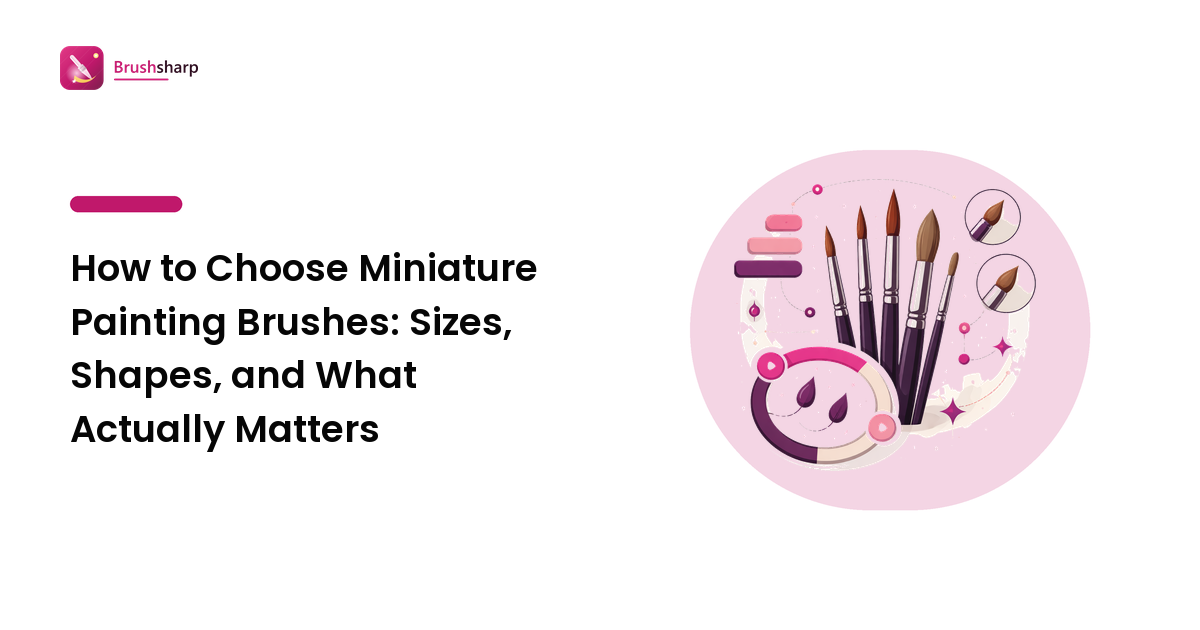
Most miniature painters need only three brushes: a size 1 or 2 round for base coats and most work, a size 0 or 00 round for detail, and a cheap stiff brush kept solely for drybrushing. Choose them by how sharply the tip points and how well the belly holds paint — not by the size number, which is not standardized between makers.
That is the whole answer, and it disappoints people who expected a shopping list of twelve brushes. Miniature painting rewards a small number of well-kept brushes far more than a big set, because the thing you are actually buying is a point — and points are made by the quality of the hair and destroyed by careless washing.
What size brush do you need for miniatures?
Beginners almost always buy too small. A tiny brush holds almost no paint, so it dries on the way to the model, forces a refill every few seconds, and leaves streaky, chalky coverage. Meanwhile a well-pointed size 1 will do eyes just fine, because the tip of a good round is a few hairs wide regardless of the body behind it.
The practical rule: buy the largest brush that still comes to a sharp point. The belly carries paint; the tip does the work. A size 1 or 2 round is the true workhorse — it will base coat a 28 mm model, cut in armour panels, and pick out a buckle. Reach for a 0 or 00 only for genuinely tiny marks: pupils, freehand lines, and gem highlights.
| Brush | Typical size | What it is for |
|---|---|---|
| Main round | 1–2 | Base coats, layering, most of the model |
| Detail round | 0–00 | Eyes, buckles, freehand, fine edge highlights |
| Large round or flat | 4–6, or a 6–10 mm flat | Cloaks, bases, big vehicle panels, washes |
| Drybrush | Old or dedicated stiff round/flat | Drybrushing texture — ruins any brush, so use a sacrificial one |
| Optional rigger/liner | 0 with long hairs | Long unbroken lines: cables, banner edges, hair strands |
Size numbers vary between manufacturers, so a #1 from one maker may be visibly fatter than a #1 from another. Treat the number as a guide within a single brand and judge the actual brush by eye. If you want the wider context on shapes and numbering, our guide to art brush shapes covers how rounds, flats, filberts, and riggers each behave.
Natural or synthetic hair for miniatures?
Both work; they fail in different ways.
Natural hair — kolinsky sable is the traditional choice — has scaled, tapered fibres that hold a lot of thinned paint and snap back to a point. That combination of a big reservoir and a fine tip is exactly what miniature painting asks for, which is why sable dominates the high end. The trade-offs are real: it costs considerably more, it is easy to ruin with harsh cleaners or by letting paint dry in the heel, and hair quality varies even within a brand.
Synthetic filaments are extruded nylon or polyester. They are springier and stiffer, cheaper, easier to clean, and completely unbothered by the water-based acrylics almost all miniature paint is. They hold less paint than sable and their points soften with wear, but good modern synthetics are genuinely capable, and there is no shame in painting an entire army with them. Because they are cheap enough to replace, many painters use synthetics for anything abrasive — drybrushing, metallics, texture paste — and save one sable round for detail.
A practical middle path: one good natural-hair round in size 1, plus synthetics for everything else. We compare the two materials in more depth in synthetic vs natural bristle brushes.
How do you judge a brush before you buy it?
Five checks, in order:
- Look at the point dry. A good round tapers to a single fine tip with no stray hairs sticking out sideways. Strays never improve with use.
- Wet it if the shop allows. Dip in clean water and flick once — the hairs should collapse into one crisp point, not a fork or a hook.
- Check the ferrule. It should be seamless or tightly crimped and firmly glued to the handle. A loose or split ferrule lets water in, and trapped water is what eventually pushes hairs out.
- Feel the spring. Press the tip gently against your thumbnail and release: it should snap straight back. A limp brush will not hold an edge highlight.
- Ignore the set. Ten-brush starter bundles are usually made to a price, and most of the shapes will never leave the drawer. Two good brushes beat ten mediocre ones.
Which brushes should you never use for detail?
Anything you drybrush with. Drybrushing means scrubbing a nearly paint-free brush across raised texture at an angle — the single most destructive thing you can do to bristles. It splays the tip permanently and grinds pigment into the ferrule. Buy a cheap stiff synthetic (or retire a worn-out round) and keep it exclusively for that job.
The same applies to metallic and texture paints. Metallic pigments are coarse and abrasive, and they lodge in the heel of the brush where they are hard to rinse out. Use a mid-tier synthetic for metallics, not your best sable.
How do you keep a miniature brush pointed?
Miniature brushes die from paint drying in the heel — the hidden base of the bristles where they enter the ferrule. Dried acrylic there wedges the hairs apart, and no amount of later cleaning brings the point back. Prevention is the entire game:
- Never load past the belly. Dip only the first third to half of the hairs. Paint above that line goes straight into the heel.
- Rinse before the paint sets. Acrylic skins over in minutes on a brush. Rinse in clean water whenever you pause, not just at the end.
- Wash gently after each session. Lukewarm water and a mild soap or a dedicated brush soap, worked into the palm of your hand, then rinsed until the water runs clear.
- Reshape while damp. Pull the hairs back to a point between clean fingers or lips before drying. This is what actually maintains the tip.
- Dry horizontal or tip-down. Never leave a brush standing in a water pot, and never dry it point-up — water runs into the ferrule, swells the glue, and loosens hairs.
Note on solvents: miniature paint is acrylic, so plain water is the correct cleaner and solvents are unnecessary. If you also paint in oils — increasingly common for miniature washes and weathering — those brushes need mineral spirits (white spirit) instead, because water will not dissolve oil binder. Use solvents only with good ventilation, keep them off your skin, and dispose of used spirits and rags at a household hazardous-waste point rather than down the sink. Our brush care guide covers the full routine for both.
FAQ
What is the best brush size for painting miniatures?
A size 1 or 2 round for most work and a 0 or 00 for fine detail. Bigger brushes hold more paint and stay wet longer, and a well-made round still comes to a point fine enough for eyes, so there is rarely a reason to go smaller than 00.
Do I need kolinsky sable brushes for miniatures?
No. Sable holds more thinned paint and returns to a sharper point, which makes detail work easier, but good synthetics handle acrylics perfectly well and cost far less. A common compromise is one sable round for detail and synthetics for base coats, metallics, and drybrushing.
Why does my miniature brush splay after a few sessions?
Almost always paint drying in the heel, or drybrushing with a good brush. Load only the front half of the hairs, rinse before the acrylic sets, wash with mild soap, reshape the tip while damp, and keep a separate sacrificial brush for drybrushing.
How many brushes do I actually need to start?
Three: a main round, a detail round, and a drybrush. Add a larger round or small flat once you are painting cloaks, vehicles, or bases. Buying a big multi-brush set usually means paying for shapes you will never use.
Should I use soap or a solvent to clean my miniature brushes?
Soap and water. Miniature paints are water-based acrylics, so lukewarm water with a mild or dedicated brush soap removes them completely. Solvents such as mineral spirits are only for oil paint, and they need ventilation, skin protection, and proper disposal.
Next step
Spend your budget on two brushes you will actually use rather than a set of ten, judge them by the point instead of the number on the handle, and build the ten-second rinse-and-reshape habit that keeps that point sharp. A well-kept size 1 will outlast a drawer full of neglected ones. For more vendor-neutral brush comparisons and care routines, visit brushsharp.com.