Stand in front of the brush wall in an art store — or scroll past yet another fifty-piece set online — and the choice looks impossible. Rounds, flats, filberts, riggers; sable, hog, squirrel, a dozen proprietary synthetic names; sizes from 0000 to numbers that look like house-paint territory. It's the classic beginner's trap: the category presents itself as one giant decision when it's actually a short series of small ones.
Here is the idea that collapses the wall: you don't really choose a brush first — your medium chooses most of it for you. Water, acrylic polymer, and oil are physically different substances, and each asks for different hair, different stiffness, and different handling. Decide the medium, and most of the wall stops applying to you. What's left — shape, size, and how much to spend — are quick decisions with clear reasons, and this guide walks through all of them.
One thing worth knowing up front: modern synthetic filaments have improved enormously, and the old rule that serious painting requires natural hair no longer holds. Where natural hair still earns its place is covered below.
The three jobs every brush does
Every art brush, whatever the label says, is judged on three things:
- Holding. The belly of the brush stores liquid — water and pigment, or paint — so you're not returning to the palette after every stroke.
- Releasing. Good hair lets that load out gradually and predictably as you work, instead of dumping it in the first inch.
- Springing back. "Snap" is the bristles' return to shape when you lift. It's what keeps a round pointing and a flat edging stroke after stroke.
The three media weight these jobs differently — watercolor is mostly about holding and releasing, acrylic mostly about spring and toughness, oil mostly about stiffness — and that difference drives everything below. The anatomy is the same everywhere: hair or filament, the metal ferrule clamping it, and a handle that comes short (for close work at a table, the watercolor norm) or long (for standing back at an easel, the oil norm).
Watercolor: the belly and the point
Watercolor asks the most of a brush's holding and release. The brush must drink up a wash, let it out evenly across a broad stroke, and still snap to a fine point for the branch, the eyelash, the mast. That's why the round is the heart of watercolor: one good round with a full belly and a sharp point covers a remarkable range of marks on its own.
Natural hair — sable most famously — earned its reputation here, because its scaled, tapered structure holds a lot of liquid and releases it beautifully. The trade-off is cost, and it's substantial. Today's watercolor synthetics imitate that taper well: they hold somewhat less liquid, but they're springier, far cheaper, and much more forgiving of imperfect care. For a first watercolor brush, a quality synthetic round is the sensible buy; the wet-point test is what matters — wet it, flick it, and see whether it comes back to a single point.
A watercolor round lives or dies by its tip, and the tip dies from habits, not from use — resting it point-down, letting pigment dry in the belly, hot water. The full routine for protecting it is in how to keep a watercolor brush's point sharp.
Acrylic: spring and survival
Acrylic is the brush-killer of the three. It's heavier-bodied than watercolor, so it needs stiffer bristles to push it around — and it dries fast into a water-resistant plastic, so any paint left near the ferrule sets like glue. An acrylic brush therefore needs two virtues above all: enough spring to move thick paint, and the toughness to survive constant rinsing and vigorous washing.
That's why synthetics own this medium. Natural hair is wasted in acrylic — water swells it, the polymer clings to it, and the frequent aggressive cleaning that acrylic demands wears it out fast. A set of stiff synthetic filberts, flats, and rounds costs little, works hard, and can be replaced without grief. The cardinal rule is behavioral, not material: never let acrylic dry in the bristles, and keep resting brushes in water only up to the bristles, never soaking past the ferrule. Shapes, stiffness grades, and working habits for this medium get their own full treatment in which brushes work best for acrylic painting.
Oil: stiffness and solvent tolerance
Oil paint is dense, and moving it across a textured canvas takes bristle with real backbone. This is hog bristle's home ground: stiff natural bristle whose naturally split tips ("flags") grip and carry heavy paint in a way soft hair can't. Most oil painters build the core of their kit from hog flats and filberts, then add a softer brush or two — a fine synthetic or soft natural round — for glazing, blending, and detail, where stiffness would leave furrows.
The other requirement is chemical: oil brushes meet solvents at cleanup, so the hair and the ferrule glue need to tolerate them. Whatever your cleanup method — traditional solvent or the gentler oil-and-soap approach — ventilate the room, keep solvents off your skin, and dispose of used solvent properly, never down a drain. Long handles are standard here for a practical reason: oil painting is usually done standing at arm's length, and the handle keeps your hand out of the picture, literally.
Shapes: four cover almost everything
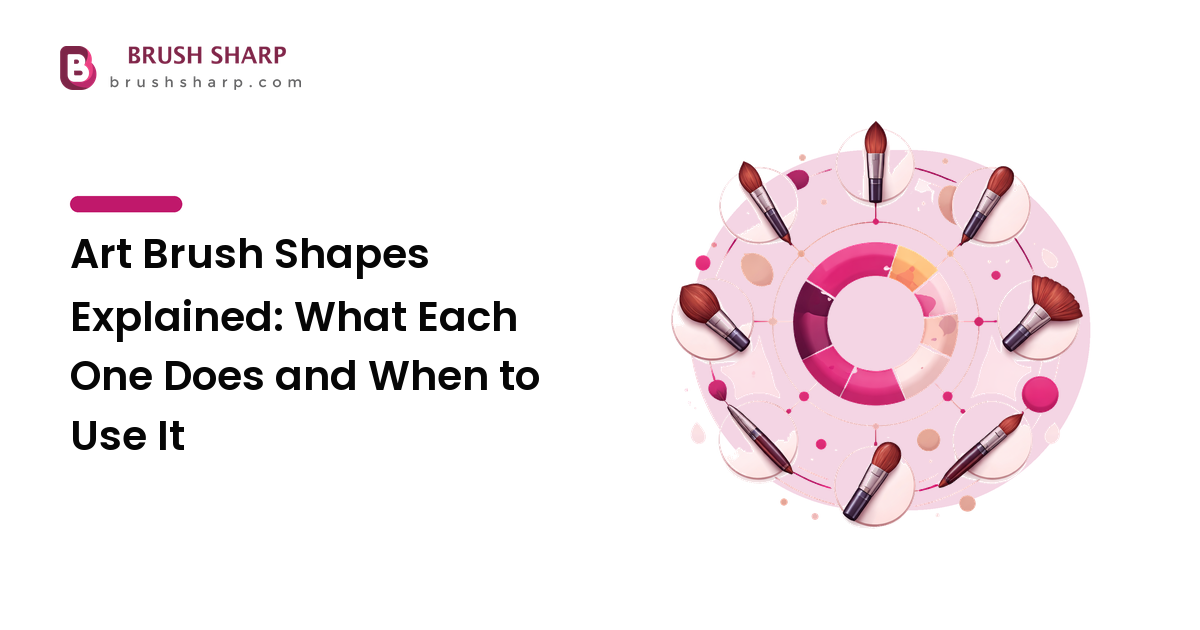
The shape wall is less intimidating than it looks, because four workhorses cover the vast majority of strokes:
- Round — the all-rounder: lines, detail, and (with a good point) everything from thin to broad in one brush.
- Flat — straight chisel edge for broad strokes, sharp edges, and blocking in shapes.
- Filbert — a flat with a rounded tip; the soft edge makes it the natural blender and the favorite for organic forms.
- Liner (rigger) — long thin hair for continuous fine lines: branches, rigging, whiskers, signatures.
Start with those and add specialists only when a specific stroke demands one. The full tour — brights, fans, mops, and when each earns its slot — is in art brush shapes explained.
Sizes: buy relative, not by number
Brush size numbers are not standardized across manufacturers — one maker's 6 can be another's 8 — so shopping by number alone across brands leads to surprises. Think instead in three relative sizes for your usual working scale: a large brush for washes and blocking in, a medium for the main work, a small for detail. When ordering online, check the stated bristle length and width rather than trusting the number.
Two practical rules. First, most beginners paint too small with brushes that are smaller still — when in doubt, size up; a bigger brush forces looser, more confident strokes and covers ground faster. Second, genuinely tiny work is its own discipline: for miniatures and fine illustration, a small brush with an excellent point beats a merely tiny brush, and how to choose miniature painting brushes explains why.
A sensible first set for each medium
No brands — just the pieces and the reasons:
- Watercolor: one medium round with a reliable point (it does most of the work) and one large flat or wash brush for skies and backgrounds. Two brushes, honestly, is enough to learn on.
- Acrylic: a medium synthetic filbert, a larger flat, and a small round — stiff enough to move body paint, cheap enough to replace when the medium eventually wins.
- Oil: two hog filberts or flats in different sizes for the main work, plus one soft round for detail and blending.
Then follow the one upgrade rule that never misleads: replace the single brush you reach for most with a better version of itself. Your own hand tells you where the money should go.
Where quality pays — and where it doesn't
Spend on the brush whose tip or edge you depend on. In watercolor that's the main round: its entire value is the point, and quality shows in every stroke. In oil and acrylic, quality matters most in the soft detail brushes; the workhorse bristle brushes are consumables by nature and mid-range serves fine. And keep one or two frankly cheap brushes in every kit for the abuse jobs — scrubbing, drybrush, texture, gesso — so your good brushes never do them.
The natural-versus-synthetic question deserves its own weighing of cost, feel, and durability: synthetic vs. natural bristle brushes walks through it fairly. But the biggest multiplier on any brush budget isn't the buying at all — it's the care. A mid-range brush cleaned promptly, reshaped damp, and stored dry will outlast an expensive one that's neglected, in every medium.
FAQ
Do I need natural hair to paint seriously?
No. Quality synthetics now handle all three media well, and they're the right default for acrylic outright. Natural hair still earns its premium in two places: sable-type hair for watercolor, where its liquid-holding capacity is unmatched, and hog bristle for oil, where its stiffness and flagged tips move heavy paint best.
Can I use the same brushes across watercolor, acrylic, and oil?
Keep separate sets. Oil residue contaminates water media, acrylic's aggressive washing wears out soft watercolor hair, and the cleaners differ — solvents for oil would be pointless punishment for a watercolor round. Dedicated sets last longer and behave predictably.
Why is a size 6 from one brand bigger than a size 6 from another?
Because there's no universal sizing standard — each manufacturer numbers its own range. Compare actual bristle length and width when switching brands, and buy by relative size (small, medium, large for your working scale) rather than by the number.
How many brushes do I actually need to start?
Two or three per medium, chosen for reasons — a round and a wash brush for watercolor; a filbert, flat, and round for acrylic or oil. Skill grows faster than the kit needs to: a big set mostly teaches you which forty brushes you never touch.
When is a brush actually worn out?
When the tip stays splayed after a proper deep clean and damp reshaping, when it sheds steadily from the ferrule, or when the ferrule itself is loose. Dirty and misshapen are fixable; try a full clean and reshape before passing a verdict — a stiff brush in particular is often revivable rather than dead.
Next step
Pick your medium's short list — a round and a wash brush for watercolor, stiff synthetics for acrylic, hog plus one soft round for oil — and buy small for stated reasons rather than big for the piece count. Then protect the investment: the brush care guide covers the cleaning, reshaping, and storage routines that keep a good brush sharp for years, whatever you paint with. For more on choosing and keeping every kind of brush, visit Brush Sharp.