A worn toothbrush head is the same failure as a worn paintbrush: the bristles have splayed, they no longer stand up to the surface, and the tool has quietly stopped doing the job while feeling exactly the same in your hand. The difference is that a bad paint job is visible immediately, so nobody argues with the diagnosis.
The takeaway up front: replace an electric toothbrush head roughly every three months, or sooner the moment the bristles splay past the head's outline. The calendar is a default; the bristles are the actual instruction. Anyone who brushes hard, uses a whitening or "deep clean" mode constantly, or has been ill will get there faster — and a head that looks flattened after five weeks is telling you something about your technique, not about the product.
Why bristles stop working
The mechanism is straightforward and it's the same across every brush category we cover on this blog.
A filament works by being stiff enough to bend at the tip and spring back. That flexing does the cleaning. Over thousands of cycles, two things happen: the nylon takes a permanent set — it stops returning to straight — and the filament ends, which are rounded and polished when new, abrade into rougher, splayed ends. A splayed bristle presents its side to the surface rather than its tip. It sweeps past the places you actually need it to reach, which on a tooth means the gumline and the gaps between teeth.
This is the same physics that makes a synthetic paintbrush leave streaks once its tip has gone, and it's why filament quality matters more than bristle count — the point we make in our comparison of synthetic and natural bristle brushes. Powered heads are worked far harder than a hand brush, which is why the replacement interval is the same three months despite the shorter contact time.
The wear signs, in order of usefulness
Run through these once a month. It takes ten seconds in front of the mirror.
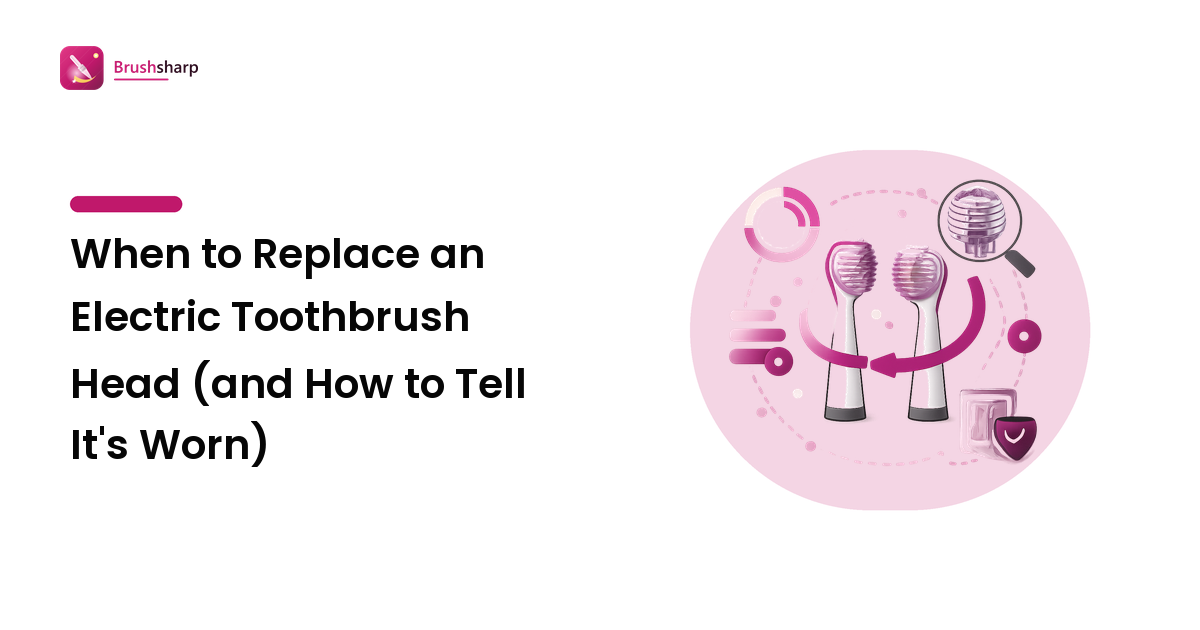
- Splay past the outline. Look straight down at the head. Any bristle bending outside the edge of the head's footprint means replace now. This is the single most reliable sign.
- Faded indicator bristles. Many heads include coloured filaments that fade toward the base as they wear — Oral-B's blue indicator bristles are the best-known version. When the colour has gone roughly halfway down, the head is done. It's a wear gauge, not a timer, so it responds to how hard you brush.
- A flattened or matted centre. The middle tufts losing their shape while the outside stays neat is the classic signature of too much pressure.
- Discolouration at the base of the tufts that doesn't rinse away.
- A change in sound or feel. A head that rattles, wobbles on the shaft, or has become noticeably noisier has usually worn at the coupling, and that's a replacement regardless of bristle condition.
- Any illness in between. After a cold, flu, or a throat infection, change the head. It costs little and removes the question.
What makes heads wear faster
If you're replacing every six weeks, one of these is usually the cause — and fixing it saves more than the heads do.
Pressure. By far the biggest factor. A powered brush is designed to be guided, not pushed; the motor supplies the movement. Leaning on it flattens the bristles, and dentists consistently warn that heavy brushing with stiff bristles contributes to gum recession and worn enamel surfaces over time. If your handle has a pressure sensor, take it seriously — it exists because this is the most common user error. If it doesn't, hold the handle in your fingertips rather than your fist.
Bristle stiffness. Soft is the standard recommendation from dental professionals for everyday use; medium and hard bristles clean no better in normal use and are harsher on gums. Softer filaments also splay sooner, which is a fair trade.
Storage. A head left in a closed travel case or capped while wet stays damp, and damp is what encourages growth on any bristle — the same reason we bang on about drying in our brush care guide and about hygiene in dirty makeup brushes and breakouts. Bristles up, in open air, is the rule for every brush you own.
Toothpaste choice. Highly abrasive whitening pastes work on the filaments as well as the enamel.
Genuine, compatible, or counterfeit?
This is where money is actually lost, and it's become a real problem as brush heads have moved onto open marketplaces.
Genuine heads are made by the handle's manufacturer. They cost the most, and the fit at the coupling is exact — which matters more than it sounds, because a loose coupling wastes motor energy and wears the shaft.
Compatible (third-party) heads are legitimate products from other manufacturers designed to fit a given handle. They're cheaper, and quality genuinely varies: the things to check are whether the filament ends are end-rounded (polished rather than cut square — square-cut ends are harsher on gums), whether the coupling is snug with no wobble, and whether the head interferes with any handle features. Note that pressure sensors and mode/head recognition often only work fully with the manufacturer's own heads.
Counterfeits are the ones to actually worry about: fakes sold as the genuine brand, usually via a marketplace third-party seller at a price that's too good. Both major manufacturers now run authentication features on their packaging for exactly this reason. Warning signs are worth memorising:
- A price far below every other seller for a supposedly genuine multipack.
- Packaging with off-colour printing, poor-quality photos on the listing, or a missing authentication code or hologram.
- Bristles that look uneven, feel scratchy, or shed on first use.
- A shaft that fits loosely, or a head that vibrates audibly differently from your last one.
- Reviews mentioning "not the same as the ones from the shop".
Buy heads from the manufacturer, a pharmacy, a supermarket, or a retailer selling as the seller of record rather than a marketplace stranger. A counterfeit head is unregulated plastic going in your mouth twice a day, and the saving is a few pounds.
Simple care that gets you the full three months
- Rinse the head under running water after every use, with the brush running for a second or two to throw off paste.
- Wipe the metal shaft and the collar of the handle weekly. Paste and water collect in that seam, dry into a crust, and eventually stop the head seating properly. A cotton bud and warm water is all it needs.
- Take the head off once a week and rinse underneath it.
- Store upright and uncovered, away from the toilet, and don't cluster heads together so they touch.
- Never share a head, and if two people use one handle, use visibly different heads or colour rings.
- Don't boil, dishwash, or microwave a head. Heat deforms the filaments and warps the coupling — the same reason hot water ruins paint and makeup brushes.
- In a hard-water area, an occasional soak of the handle base in a mild vinegar solution keeps scale off the shaft. Rinse it thoroughly and never submerge a handle that isn't rated for it.
A replacement routine that actually happens
Everyone knows the three-month rule and almost nobody follows it, because there's no trigger. Give it one:
- Buy heads in a multipack so a replacement is always within reach — the friction of "I'll order some" is what makes people run a head for eight months.
- Pick four fixed dates a year — the start of each quarter is easiest — and set a recurring reminder.
- Do the ten-second splay check monthly, and replace early when it fails. The calendar is the backstop, not the rule.
- Change after every illness, regardless of the date.
- Label heads in a shared bathroom with the coloured rings that ship with most models.
FAQ
How often should I really replace an electric toothbrush head?
About every three months as a default, and sooner if the bristles splay, the indicator bristles have faded, or you've been ill. Manufacturers and dental bodies converge on roughly the same interval for both manual and powered brushes. If you're consistently reaching the wear signs well before three months, look at your brushing pressure first.
Are cheaper generic brush heads any good?
Some are perfectly serviceable and some aren't, so judge the specific product rather than the category. Check that filaments are end-rounded, that the head seats without wobble, and that you're not losing handle features that depend on genuine heads. What's never worth it is a counterfeit sold as genuine — that's a different thing from an honestly branded compatible head.
Can I clean a brush head to make it last longer?
Cleaning keeps a head hygienic; it doesn't restore worn filaments. Once nylon has taken a permanent bend it stays bent, so no soak, sanitiser, or UV device brings the cleaning action back. Rinse and dry properly to reach three months in good condition — then replace.
Does a worn head damage my gums?
Worn, splayed bristles clean less effectively, and rough or square-cut filament ends are harsher on gum tissue than properly end-rounded ones. Combined with heavy pressure, that's the pattern dentists associate with irritation and recession over time. If your gums bleed regularly or feel sore, see a dentist rather than troubleshooting it with hardware — that's outside what a brush guide can answer.
A brush is only as good as its bristles — powered or not. Run the splay check this week, and if the head's due, compare electric toothbrushes and brush heads on BrushSharp before you buy a replacement.